
In today’s fast-paced business landscape, the ability to adapt, innovate, and deliver value quickly is paramount. Traditional ‘waterfall’ project management methodologies, with their rigid structures and lengthy planning phases, often struggle to keep up with dynamic market demands and evolving customer needs. This is where agile project management shines. Born from the software development world, agile has transcended its origins to become a cornerstone of effective project delivery across virtually all industries.
But what exactly is agile project management? Why has it become such a powerful force in modern organizations? And how can you, whether you’re a seasoned project manager or just starting, harness its potential to achieve unparalleled success? This comprehensive guide will demystify agile, exploring its foundational principles, popular methodologies, practical tools, and best practices. By the end, you’ll have a clear roadmap to implementing agile strategies that foster collaboration, enhance flexibility, and drive superior project outcomes.
What is Agile Project Management?
At its core, agile project management is an iterative approach to delivering projects throughout their lifecycle. Instead of attempting to deliver everything at once at the end, agile breaks down projects into smaller, manageable chunks, known as iterations or sprints. Each iteration involves cross-functional teams working collaboratively to deliver a potentially shippable increment of the product or service. This iterative process allows for continuous feedback, adaptation, and improvement, ensuring that the final product truly meets customer expectations and market demands.
The Agile Manifesto: Guiding Principles
The philosophy of agile is rooted in the Agile Manifesto, published in 2001 by seventeen software developers. While initially focused on software, its values and principles are universally applicable. The Manifesto prioritizes:
- Individuals and interactions over processes and tools
- Working software over comprehensive documentation
- Customer collaboration over contract negotiation
- Responding to change over following a plan
These four core values are supported by twelve principles that emphasize customer satisfaction, early and continuous delivery, welcoming change, frequent delivery, collaboration between business and developers, motivated individuals, face-to-face conversation, sustainable development, technical excellence, simplicity, self-organizing teams, and regular reflection on how to become more effective. Understanding these principles is crucial for anyone looking to truly embrace agile project management.
Why Embrace Agile Project Management?
The benefits of adopting an agile project management approach are numerous and impactful, driving significant improvements in project delivery and organizational efficiency. Here are some of the key advantages:
- Increased Flexibility and Adaptability: Agile’s iterative nature allows teams to respond quickly to changing requirements, market shifts, or unforeseen challenges. This flexibility minimizes the risk of delivering an outdated or irrelevant product.
- Enhanced Customer Satisfaction: By involving customers throughout the development process and delivering working increments frequently, agile ensures that the final product aligns closely with their needs and expectations, leading to higher satisfaction.
- Faster Time to Market: Delivering valuable features in short iterations means that parts of the product can be released earlier, allowing organizations to capitalize on market opportunities more quickly.
- Improved Quality: Continuous testing and feedback loops throughout each sprint help identify and rectify defects early, leading to a higher quality end product.
- Better Collaboration and Team Morale: Agile promotes self-organizing, cross-functional teams and encourages open communication. This fosters a sense of ownership, trust, and shared responsibility, boosting team morale and productivity.
- Reduced Risk: Breaking down large projects into smaller, manageable pieces makes it easier to identify and mitigate risks early in the development cycle, preventing costly failures.
- Greater Transparency: Agile methodologies often employ visual tools like Kanban boards and daily stand-ups, providing clear visibility into project progress, challenges, and team performance for all stakeholders.
Key Methodologies in Agile Project Management
While the Agile Manifesto provides the overarching philosophy, several distinct methodologies offer frameworks for implementing agile project management in practice. The most popular include Scrum, Kanban, and Lean.
Scrum: The Most Popular Agile Framework
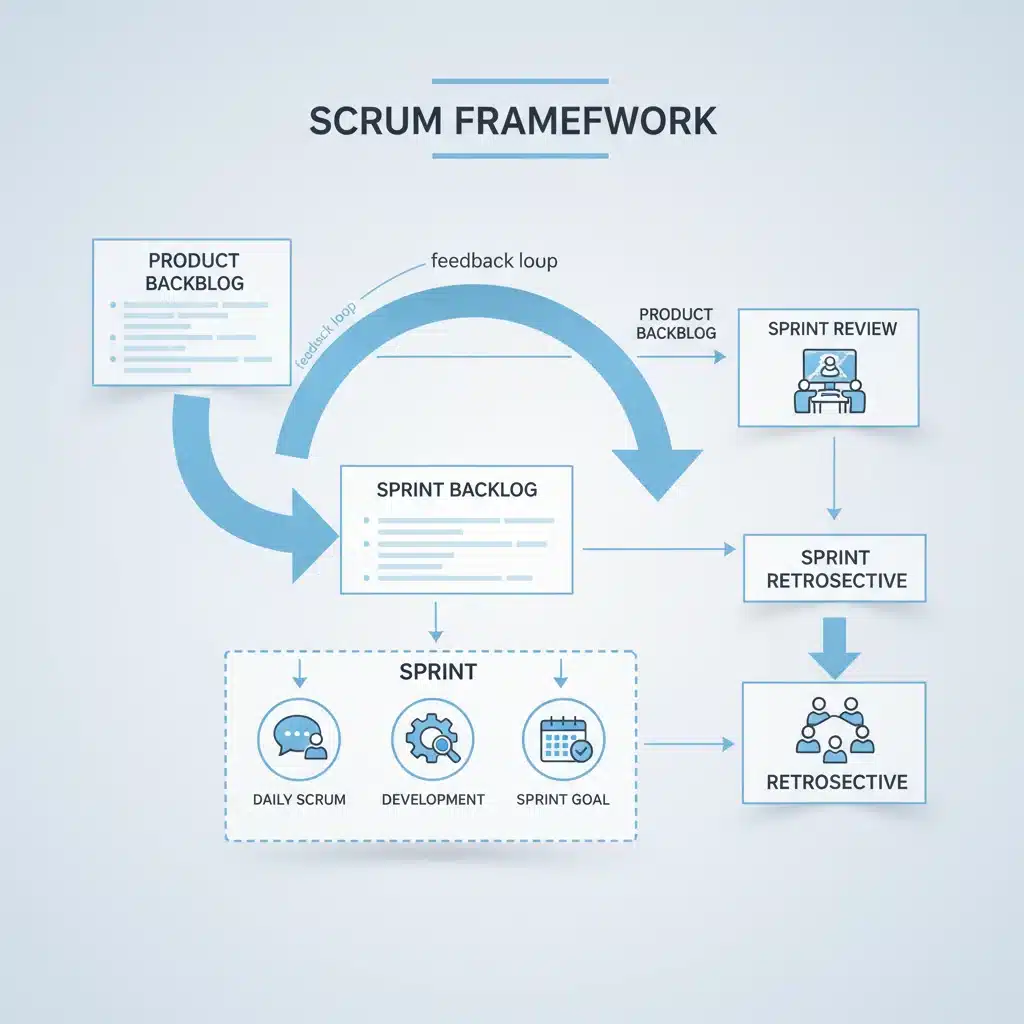
Scrum is arguably the most widely adopted framework within agile project management. It’s an empirical process that emphasizes teamwork, accountability, and iterative progress toward a well-defined goal. Scrum operates on the principle of short, time-boxed iterations called ‘sprints,’ typically lasting 1-4 weeks.
Scrum Roles:
- Product Owner: Responsible for maximizing the value of the product resulting from the work of the Development Team. They manage the Product Backlog.
- Scrum Master: A servant-leader who helps the team understand Scrum theory, practices, rules, and values. They facilitate Scrum events and remove impediments.
- Development Team: A self-organizing, cross-functional group responsible for delivering a ‘Done’ increment of product at the end of each sprint.
Scrum Events:
- Sprint Planning: The team plans the work to be performed in the upcoming sprint.
- Daily Scrum (Stand-up): A short daily meeting (15 minutes) for the Development Team to synchronize activities and create a plan for the next 24 hours.
- Sprint Review: The Development Team presents the results of their work to key stakeholders and progress toward the Product Goal is discussed.
- Sprint Retrospective: The team inspects how the last sprint went with regards to individuals, interactions, processes, and tools, and identifies improvements for the next sprint.
Scrum Artifacts:
- Product Backlog: An ordered list of everything that might be needed in the product.
- Sprint Backlog: The set of Product Backlog items selected for the Sprint, plus a plan for delivering the product increment and realizing the Sprint Goal.
- Increment: The sum of all the Product Backlog items completed during a Sprint and the value of the increments of all previous Sprints.
Kanban: Visualizing Workflow
Kanban, another powerful methodology within agile project management, originated from Toyota’s manufacturing process. Its primary focus is on visualizing work, limiting work in progress (WIP), and maximizing efficiency. Unlike Scrum’s time-boxed sprints, Kanban is a continuous flow system.
Key Principles of Kanban:
- Visualize the workflow: Use a Kanban board (physical or digital) to represent different stages of work (e.g., To Do, In Progress, Testing, Done).
- Limit Work in Progress (WIP): Restrict the number of items in each stage to prevent bottlenecks and ensure focus.
- Manage flow: Monitor and improve the movement of work items through the system.
- Make process policies explicit: Clearly define how work moves through the system.
- Implement feedback loops: Regularly review and adapt the process.
- Improve collaboratively, evolve experimentally: Encourage continuous improvement based on data and team input.
Kanban is particularly effective for maintenance projects, support teams, or any environment where work arrives unpredictably and needs continuous delivery.
Lean Software Development: Eliminating Waste
Lean principles, also originating from Toyota, focus on maximizing customer value while minimizing waste. When applied to agile project management, Lean emphasizes seven core principles:
- Eliminate Waste: Identify and remove anything that doesn’t add value to the customer (e.g., unnecessary features, waiting time, defects).
- Amplify Learning: Foster a culture of continuous learning and experimentation.
- Decide as Late as Possible: Defer decisions until the last responsible moment to allow for more information gathering.
- Deliver as Fast as Possible: Focus on rapid delivery of value.
- Empower the Team: Trust and empower your teams to make decisions.
- Build Integrity In: Ensure quality is built into the process from the start.
- See the Whole: Understand the entire value stream from end to end.
Lean can be integrated with Scrum or Kanban to further optimize processes and enhance efficiency within an agile project management context.
Implementing Agile Project Management: Practical Steps
Transitioning to agile project management requires more than just adopting a framework; it demands a shift in mindset and organizational culture. Here are practical steps to successfully implement agile in your projects:
1. Start Small and Scale Gradually
Don’t try to implement agile across your entire organization overnight. Begin with a pilot project or a single team. This allows you to learn, adapt, and refine your approach before scaling. Choose a project that is relatively low-risk but still offers tangible benefits from an agile approach.
2. Form Cross-Functional, Self-Organizing Teams
Agile thrives on small, dedicated teams (typically 5-9 members) that possess all the skills necessary to complete a project increment from start to finish. Empower these teams to make decisions and manage their own work, fostering a sense of ownership and accountability.
3. Prioritize Ruthlessly with a Product Backlog
The Product Backlog is the single source of truth for all work to be done. The Product Owner must continuously prioritize items based on business value, customer needs, and technical dependencies. This ensures that the team is always working on the most important tasks.
4. Embrace Iterative Development (Sprints/Iterations)
Break down large features into smaller, manageable user stories that can be completed within a single sprint. Focus on delivering a ‘potentially shippable’ increment at the end of each iteration. This allows for continuous feedback and course correction.
5. Foster Continuous Communication and Collaboration
Daily stand-ups, regular reviews, and retrospectives are crucial for keeping the team aligned, identifying impediments, and improving processes. Encourage open and honest communication, and ensure stakeholders are involved throughout the process.

6. Use Visual Management Tools
Kanban boards, Scrum boards, and other visual aids provide transparency into the workflow, making it easy to see what’s being worked on, what’s coming up, and where bottlenecks might exist. Digital tools like Jira, Trello, Asana, and Monday.com can greatly facilitate this.
7. Collect Feedback and Adapt Constantly
Agile is all about continuous improvement. Regularly solicit feedback from customers, stakeholders, and the team itself. Use sprint retrospectives to reflect on what went well, what could be improved, and how to implement those improvements in the next iteration. This commitment to adaptation is a hallmark of successful agile project management.
8. Invest in Training and Coaching
Agile is a significant shift for many. Provide adequate training for your teams and leadership on agile principles, practices, and specific methodologies. Consider bringing in experienced agile coaches to guide the transition and embed the new ways of working.
Common Challenges in Agile Adoption and How to Overcome Them
While agile project management offers immense benefits, its adoption isn’t without hurdles. Organizations often face challenges that can hinder a successful transition. Understanding these common pitfalls and knowing how to address them is key to sustained agile success.
1. Resistance to Change
Challenge: People are naturally comfortable with existing processes. Introducing agile can be met with skepticism, fear of the unknown, or a perception of increased workload, especially from those accustomed to traditional methods.
Solution: Start with clear communication about the ‘why’ behind the agile transition – explain the benefits for individuals, teams, and the organization. Involve key stakeholders and team members in the planning process. Provide comprehensive training and coaching. Celebrate small wins and highlight success stories to build momentum and show tangible results.
2. Lack of Management Buy-in and Support
Challenge: If leadership doesn’t fully understand or commit to agile, it can undermine the efforts of teams. Managers might revert to micro-managing or demand traditional metrics that conflict with agile principles.
Solution: Educate senior management on agile principles and the value it brings. Demonstrate how agile aligns with strategic business goals. Secure their visible sponsorship and active participation, especially in review meetings. Leadership needs to model agile behaviors and trust their self-organizing teams.
3. Insufficient Training and Understanding
Challenge: Simply telling teams to ‘be agile’ without providing proper training on specific frameworks (like Scrum or Kanban), roles, and ceremonies often leads to confusion, frustration, and a superficial implementation of agile.
Solution: Invest in thorough training for all team members, Product Owners, and Scrum Masters. This includes foundational agile concepts, specific framework mechanics, and the underlying mindset shift. Consider bringing in external agile coaches for hands-on guidance and mentorship during the initial phases.
4. Inconsistent Application Across Teams/Departments
Challenge: Different teams or departments might adopt agile at varying paces or interpret its principles differently, leading to inconsistencies, integration issues, and a fragmented agile ecosystem within the organization.
Solution: Establish a common understanding of agile principles and a baseline framework (e.g., ‘our flavor of Scrum’). Encourage cross-team collaboration and knowledge sharing. Implement communities of practice for Scrum Masters and Product Owners to share experiences and best practices. Consider scaling agile frameworks (like SAFe or LeSS) for larger organizations, but be mindful of their complexity.
5. Over-focus on Tools, Under-focus on Principles
Challenge: Organizations sometimes mistakenly believe that buying an agile project management tool (e.g., Jira) makes them agile. They focus on configuring the tool without internalizing the underlying values and principles.
Solution: Emphasize that tools are enablers, not solutions in themselves. Prioritize understanding and living the Agile Manifesto’s values and principles. Use tools to support agile practices, not dictate them. Regularly review whether the tools are genuinely helping the team be more agile and collaborative.
6. Difficulty in Estimating and Planning in an Iterative Environment
Challenge: Traditional project managers are used to upfront, detailed planning and fixed timelines. Agile’s iterative nature can make estimation and long-term planning feel less precise or even impossible.
Solution: Embrace agile estimation techniques like story points and relative sizing. Understand that agile planning is adaptive and continuous, not a one-time event. Use release planning and roadmaps for longer-term vision, but allow flexibility. Focus on delivering value incrementally and inspecting frequently to adjust forecasts.
7. External Dependencies and Stakeholder Management
Challenge: Even if a team is agile, they often rely on external teams or departments that are not, creating bottlenecks and communication challenges. Managing stakeholders accustomed to traditional reporting can also be difficult.
Solution: Proactively identify and manage dependencies. Work with external teams to understand their processes and find ways to integrate. Educate stakeholders on agile reporting (e.g., burn-down charts, velocity) and emphasize the value of frequent, transparent communication over lengthy documentation. Involve them in sprint reviews to build trust and understanding.
The Future of Agile Project Management
Agile project management is not a fad; it’s a fundamental shift in how organizations approach work. Its principles are continuously evolving and expanding beyond software development to areas like marketing, HR, and even strategic planning. As businesses face increasing complexity and rapid change, the demand for agility will only grow.
Emerging trends in agile project management include:
- Hybrid Approaches: Combining agile with traditional methods to suit specific project needs.
- Scaled Agile Frameworks: Solutions like SAFe, LeSS, and Scrum@Scale for applying agile at an enterprise level.
- Agile Leadership: A greater focus on developing leaders who embody agile values and empower their teams.
- Business Agility: Extending agile principles beyond IT to transform entire organizational structures and cultures.
- AI and Automation in Agile: Leveraging artificial intelligence and automation to streamline agile processes, enhance analytics, and improve decision-making within agile teams.
Conclusion: Embracing Agile for Sustained Success
Agile project management offers a powerful paradigm for navigating the complexities of the modern business world. By prioritizing individuals and interactions, working solutions, customer collaboration, and responsiveness to change, organizations can foster innovation, accelerate delivery, and achieve greater customer satisfaction. While the journey to full agile maturity may present challenges, the rewards – increased flexibility, improved quality, higher team morale, and reduced risk – are well worth the effort.
Whether you choose Scrum, Kanban, or a blend of methodologies, remember that the true spirit of agile lies in continuous learning, adaptation, and a relentless focus on delivering value. By embracing these core tenets, you’ll not only master your projects but also build a more resilient, responsive, and successful organization. Start your agile journey today, and unlock a new level of project excellence.